(Coordination: Sophie Cravatte (IRD), Catherine Sabinot (IRD), Guillaume Mitta (IFREMER))
Marine heatwaves are prolonged episodes of extreme ocean temperatures that can have devastating effects on marine ecosystems, such as massive coral bleaching, coastal species mortality, and toxic algal blooms. The intensity and frequency of marine heatwaves are expected to increase in the future, posing a growing threat to island societies that heavily rely on marine resources.
MaHeWa is an interdisciplinary project funded for four years (2024–2028) by the French National Research Agency (ANR) as part of the Priority Research Program “Ocean and Climate: An Ocean of Solutions.”
This project brings together a consortium of climatologists, oceanographers, biologists, anthropologists, and economists from France and overseas institutes and universities. These teams collaborate to make significant advances in understanding the characteristics and impacts of marine heatwaves on socio-ecological systems in Pacific Overseas Territories.


MaHeWa will study:
Throughout the project, MaHeWa will facilitate close collaboration between scientists and the project’s partner territorial managers responsible for health and marine resources.
|
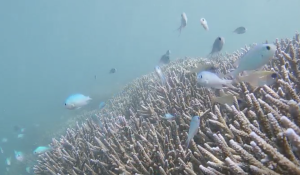
International collaboration · April 2026 Australian researchers in Bouraké studying reef fish resilience to climate change |
|
As part of a collaboration funded by the French Embassy in Australia (Australian-French Student Exchanges in the Pacific 2025) and the University of Adelaide, |
|
New intern · March 2026 Welcome to Axelle Saget-Lethias, MaHeWa intern studying microbial biodiversity in the southern lagoon |
|
As part of her third and final year of the Bachelor of Technology in Biological Engineering, specialising in Environmental Sciences and Ecotechnologies, at the University of Clermont Auvergne, Axelle Saget-Lethias is currently undertaking a four-month internship at Ifremer, from 16 March to 6 July. |

|
Awareness · March 2026 MaHeWa co-facilitates the Ocean Fresco in Koné alongside the Northern Province |
|
On Thursday 5 March, the Ocean Fresco workshop was held in Koné. Inspired by the Climate Fresco, the Ocean Fresco consists of six themes and uses a set of 100 cards to build a systemic view of the ocean. It is rooted in an awareness-raising approach and allows participants to discover the issues related to the ocean and the actions that can be taken to preserve it. |


